E-liquid tax: law passed by the National Assembly on November 9, 2024
An amendment to the 2025 finance bill proposing an e-liquid tax was adopted on 9 November 2024. Here is the latest news!
An amendment to the 2025 finance bill proposing an e-liquid tax was adopted on 9 November 2024. Here is the latest news!
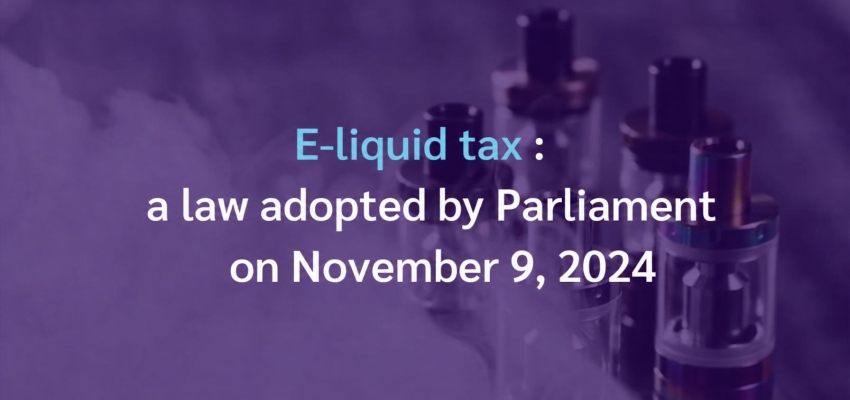
An amendment to the 2025 finance bill adopted during the night of 8 to 9 November 2024 by the National Assembly is shaking up the vaping world. Vaping products could be subject to a tax of €0.15 per millilitre of liquid. This measure would create "a dedicated tax regime" for these products and would bring up to 200 million euros into state coffers. However, this new levy on e-liquids could have significant repercussions on the vaping market in France. Consumers will need to adapt to this new fiscal reality, which could influence their product choices and consumption habits.
During the night of 8 to 9 November 2024, the National Assembly adopted amendment no. I-2885 submitted on 19 October 2024 by MP Charles de Courson. The following amendment, which put forward a proposal to increase tobacco prices, was moreover rejected. If the e-liquid tax text were to be definitively adopted, vaping would no longer be governed by the public health code under the authority of the Minister of Health, but by the tax code under the authority of the Ministry of the Budget. This change would transform vaping products into instruments to be taxed, discouraging consumers from adopting them in favour of tobacco, whereas they are today recognised as the most effective tools for combating smoking.
On 19 October 2024, an amendment to the 2025 finance bill aimed at creating a dedicated tax regime for vaping products was submitted by centrist MP Charles de Courson. It provides in particular for an excise duty of €0.15 per millilitre of liquid for all vaping products, whether or not they contain nicotine. This therefore applies to:
If the amendment were to be adopted, it would result in a 7.5% increase on refill cartridges for rechargeable puffs, 25% for 10 ml e-liquid bottles and 38% for 50 ml bottles.
According to the MP, this amendment would put an end to a French tax exemption on vaping products. Currently, these products are regulated in France but not taxed. Yet, 19 European countries have already taxed this product at the following rates:
According to estimates by MP Charles de Courson, this new e-liquid tax could generate between 150 and 200 million euros for the French state each year.
The e-liquid taxation project is only in the early stages of a lengthy legislative process. If it were to be adopted by the Senate, the text would need to be finalised before 21 December 2024 for possible enactment before 31 December of that year. If the finance bill is passed, the taxation of e-liquids could come into force on 1 March 2025.
The amendment had not yet been deemed admissible when FIVAPE, the interprofessional vaping federation in France, published an initial official statement listing the harmful effects of such a tax. According to the federation, this measure would be a boost for the tobacco industry and would act as a barrier to the efforts of smokers who choose vaping to quit smoking.
The federation suspects tobacco manufacturers of wanting to curb the growth of vaping to protect their interests, by discouraging smokers who wish to quit tobacco in favour of the e-cigarette. These manufacturers offer disposable e-cigarettes (puffs) and cartridges that contain little e-liquid and would therefore be barely affected by the introduction of an excise duty of €0.15 per millilitre of e-liquid. In contrast, the independent vaping industry, which holds 85% of the market, would be impacted with a tax up to 6 times higher than that levied on the tobacco industry. This tax would therefore benefit the closed systems of the tobacco industry. FIVAPE also highlights the lack of transparency regarding the manufacture of vaping products by the tobacco industry, which are mostly sourced from abroad and offered in non-recyclable single-use devices that are far more polluting.
FIVAPE also demonstrates that such a price increase could discourage smokers from making the transition to the e-cigarette. When one considers that the main motivation for this change is the savings made, this bill could undermine that motivation or even encourage vapers to return to traditional cigarettes. Furthermore, the federation tempers the estimated potential tax revenues of 150 to 200 million euros per year by pointing out that these gains will need to be weighed against the losses to social security in the event of a resurgence of smoking-related illnesses. In response to these accusations, the MP defends himself by arguing that this measure will have "a moderate impact on prices in order to preserve access to the e-cigarette for the 3.5 million consumers of the product" and thereby "avoid a possible return to cigarettes."
The interprofessional vaping federation in France also shares its concerns about the emergence of a black market in France, which would favour the sale of uncontrolled and potentially dangerous products not monitored by health authorities. In 2019, counterfeit e-liquids caused a wave of lung diseases in the United States. In conclusion of its official statement, FIVAPE asserts that "this tax would be one more step obtained by the tobacco lobby to transfer the vaping market to its points of sale and ultimately reduce its health effectiveness. Vaping is the ally of cessation. The enemy is tobacco."
Sources:
https://www.assemblee-nationale.fr/dyn/17/amendements/0324A/CION_FIN/CF1865
https://fivape.org/wp-content/uploads/2024/10/241015-Taxe015.pdf
Read the summary with

About the author
GaëlleAn SEO writer specialising in the vaping world for 5 years, I lend my pen to Le Vapoteur Discount to guide smokers who wish to quit cigarettes [...]
1 comments
Add a comment







Vigneron
2024-10-29 19:52:32
0,15 € par millilitre ??? Mais c'est bien plus que du 36% d'augmentation !!! Mon exemple : je vape en DIY et j'achète ma base 10€ les 500 millilitres (ma conso pour 2 mois et demi), soit 0,02€ le millilitre. C'est donc une augmentation de 750% sur le prix du liquide de base qui passerait de 10 à 85 € !!!