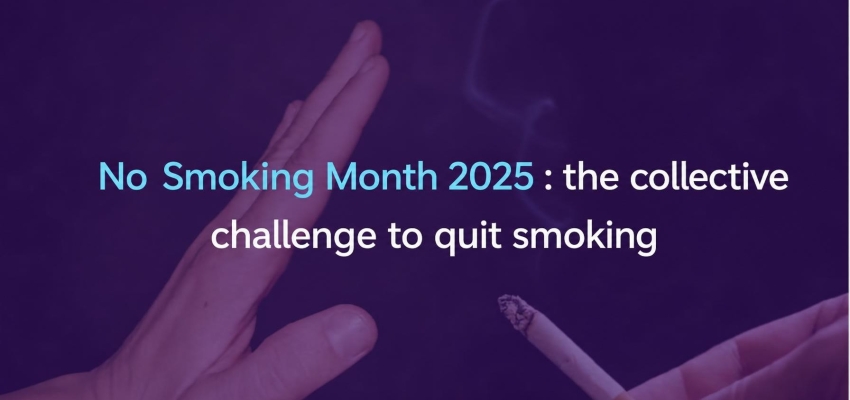
France's No Tobacco Month returns in November 2026 for its 11th edition. The principle remains unchanged: stop smoking for 30 days, with free support. According to Santé publique France, going a month without smoking makes you five times more likely to quit in the long term[1]. Here is how to register, which official tools to use and what you need to know if you are considering an electronic cigarette to help you.
Key points
- 11th edition: the collective challenge takes place in November 2026, for 30 days; registration has been open since 1 October 2026[1].
- Free registration on the official No Tobacco Month website or via the Tabac info service app[1][3].
- Official tools: a quit support kit, an e-coaching app and 39 89, the Tabac info service helpline for free support from a tobacco cessation specialist[1][2].
- Electronic cigarette: Anses describes it as a “transitional option” for quitting smoking, for exclusive use and alongside support measures[5]. It is not a medicine and is not intended for non-smokers.
- Vaping products are for adults only.
No Tobacco Month 2026: the challenge
Launched in 2016, No Tobacco Month is run by Santé publique France and the Ministry of Health, in partnership with Assurance Maladie[1]. The idea is simple: rather than aiming to quit “forever”, which can often feel daunting, you set yourself a 30-day goal, alongside tens of thousands of other people.
This milestone was not chosen at random. According to Santé publique France, stopping smoking for 30 days makes you five times more likely to quit in the long term. The agency also states that registering and attempting to quit during the campaign doubles the one-year success rate for smoking cessation, compared with an attempt without outside support[1].
The movement has gained momentum: more than 2.5 million participations since 2016 and over 117,000 registrations in 2025[1]. For 2026, the national campaign is entitled “Becoming an Ex-Smoker”, with the message: “Taking part in No Tobacco Month increases your chances of becoming an ex-smoker”[1]. And 55% of daily smokers want to quit[1].
How do I register for No Tobacco Month 2026?
Registration has been open since 1 October 2026[1]. It takes just a few minutes:
- go to the official No Tobacco Month website, under “I register”[4];
- or register directly via the Tabac info service app[3];
- once registered, you can access the support programme and order your quit support kit[4].
Registering early, in October, gives you time to prepare to quit: choose your method, identify your “automatic” cigarettes and let those around you know.
The quit support kit
The No Tobacco Month kit contains a 40-day programme, advice and challenges, as well as a wheel for calculating your savings[4]. According to ARS Hauts-de-France, it also includes an anti-stress ball, and can be downloaded from tabac-info-service.fr or collected from a pharmacy[2]. We explain its contents in detail in our article about the No Tobacco Month kit.
The Tabac info service app
The Tabac info service e-coaching app offers a free, personalised programme: daily encouragement messages, advice from tobacco cessation specialists, mini-games, videos, tracking of savings and health benefits[1][2].
39 89: a tobacco cessation specialist on the phone
39 89 provides free support from a Tabac info service tobacco cessation specialist, with personalised follow-up; the call is not charged at a premium rate[1]. The specialist can also help you adjust nicotine treatment[2]. Your doctor, pharmacist, midwife or a smoking cessation clinic can also support you.
Electronic cigarettes: what official opinions say
Among the recognised methods for quitting smoking, Santé publique France mentions nicotine replacement therapies, behavioural support, remote help from Tabac info service and certain prescribed medicines[6]. The electronic cigarette occupies a separate position: it is neither a medicine nor a treatment, but a consumer product that some smokers use to move away from tobacco.
Several recent publications help to clarify its potential benefits:
- High Council for Public Health: cited by Santé publique France, it considers that the electronic cigarette “may be regarded as an aid to smoking cessation” for smokers who want to quit[6].
- Anses (February 2026): the agency considers that it may be envisaged as “a transitional option” for quitting smoking, provided it is part of a cessation approach, used “exclusively” and alongside existing support. It reminds us that the effects of smoked tobacco are “serious, established and very well documented”, while vaping is “associated with possible health effects”[5]. Our article on the Anses report details these conclusions.
- Cochrane Review (August 2026): this review of 80 studies involving nearly 30,000 adults concludes that nicotine e-cigarettes help more people quit smoking than nicotine replacement therapies in the studies analysed[7]. The key figures are explained in our article on the 2026 Cochrane study.
These findings do not guarantee success for any individual. Vaping is not risk-free, and the aim is to replace cigarettes completely: “dual use”, vaping and smoking at the same time, does not allow you to benefit fully from quitting tobacco. If you have never smoked, vaping is not for you. To compare other options, read our guide on methods for quitting smoking.
Getting started with vaping during No Tobacco Month
Choosing the right nicotine strength
This is the most important point. A strength that is too low leaves room for cravings and can lead you to light another cigarette; a strength that is too high may cause discomfort. The right guide depends on your consumption and dependence: our article on the amount of nicotine in a cigarette provides indicative ranges, and the Fagerström test lets you assess your dependence in six questions. In France, e-liquids contain a maximum of 20 mg/ml of nicotine. If in doubt, ask 39 89 or a healthcare professional for advice.
Choosing simple equipment
When starting out, it is best to choose equipment that is easy to use: a pod or compact kit with a tight draw (MTL), similar to the feel of a cigarette, and enough battery life to last the day. We have brought together models designed for first steps in the I'm getting started category.
Anticipating minor discomforts
During the first few days, throat irritation, a mild cough or headaches may occur: these are effects frequently reported in studies and tend to decrease over time (see our article on the Cochrane Review cited above). If they persist, speak to a healthcare professional and adjust your nicotine strength with their help.
30 days without tobacco: week-by-week programme
The official kit offers its own 40-day programme[4]. In addition, here are some practical guidelines for organising your month:
| Period |
Goal |
Practical advice |
| Late October (preparation) |
Get prepared |
Register, choose your method, note when you smoke, tell those around you, remove lighters and ashtrays. |
| Week 1 |
Get through the first few days |
Do not let yourself run short of nicotine if using a replacement therapy or vaping, drink water, stay active and avoid high-risk situations. |
| Week 2 |
Change your habits |
Replace rituals (coffee, breaks, after meals) with another activity; use the app to track your progress. |
| Week 3 |
Manage cravings |
A craving to smoke lasts a few minutes: breathe, keep your hands busy, call 39 89 if needed. |
| Week 4 |
Consolidate |
Review the savings and benefits you have felt, and plan for difficult situations in the following weeks. |
| After day 30 |
Keep going |
Maintain support, do not start again with “just one cigarette”; if vaping, consider gradually reducing your nicotine strength later on. |
A slip does not erase the days you have gained: if you smoke a cigarette, analyse the situation that led to it and resume the challenge. Many former smokers succeeded after several attempts. To stay motivated, also see the benefits of quitting tobacco over the weeks.
Frequently asked questions about No Tobacco Month 2026
When does No Tobacco Month 2026 take place?expand_more
The 11th edition takes place in November 2026, for 30 days. Registration has been open since 1 October 2026 on the official No Tobacco Month website.
How do I register for No Tobacco Month?expand_more
Registration is free and can be completed on the official No Tobacco Month website or via the Tabac info service app. It gives access to the support programme and the quit support kit.
What does the No Tobacco Month kit contain?expand_more
The kit includes a 40-day programme, advice and challenges, as well as a wheel for calculating your savings. It can be ordered after registration, downloaded from tabac-info-service.fr or collected from a pharmacy.
Why quit for 30 days?expand_more
According to Santé publique France, stopping smoking for 30 days makes you five times more likely to quit in the long term. It is a more achievable goal than deciding to quit permanently all at once.
Can I use an electronic cigarette during No Tobacco Month?expand_more
The challenge is about quitting tobacco. Anses considers that the electronic cigarette may be envisaged as a transitional option for quitting smoking, for exclusive use and with support. It is not a medicine and remains intended for adult smokers only.
What nicotine strength should I choose when starting to vape?expand_more
It depends on your cigarette consumption and your level of dependence. The Fagerström test helps assess it; a tobacco cessation specialist at 39 89 or a healthcare professional can also advise you. The maximum strength permitted in France is 20 mg/ml.
Is 39 89 free?expand_more
Yes. Tabac info service's 39 89 provides free support from a tobacco cessation specialist, with personalised follow-up, and the call is not charged at a premium rate.
What should I do if I relapse during the challenge?expand_more
One cigarette does not undo everything. Identify the situation that triggered it, resume the challenge as soon as possible and do not hesitate to seek help from 39 89 or a healthcare professional.
Sources
[1] No Tobacco Month 2026: registration opens, press release, Santé publique France, 1 October 2026. Accessed 16/10/2026.
[2] No Tobacco Month 2026: 11th edition, Hauts-de-France Regional Health Agency, 7 October 2026. Accessed 16/10/2026.
[3] 11th edition of No Tobacco Month: take up the challenge, Provence-Alpes-Côte d'Azur Regional Health Agency. Accessed 16/10/2026.
[4] No Tobacco Month, official website, Tabac info service. Accessed 16/10/2026.
[5] Vaping: what are the health risks?, Anses, 4 February 2026. Accessed 16/10/2026.
[6] Smoking cessation: which treatments are effective?, Santé publique France. Accessed 16/10/2026.
[7] Lindson N. et al., Electronic cigarettes for smoking cessation, Cochrane Database of Systematic Reviews, 2026, CD010216.pub11, published on 26 August 2026; expert overview and reactions: Expert reaction to updated review looking at vaping for smoking cessation, Science Media Centre (in English). Accessed 16/10/2026.
This article is for information purposes and does not replace advice from a healthcare professional. Vaping products are prohibited for minors and are not intended for non-smokers. Nicotine is highly addictive. For support with quitting tobacco: Tabac info service, 39 89.