Nicotine in a JNR puff: how much, and which strength to choose?
How much nicotine is in a JNR puff, what does “2%” mean and how do you choose between 0, 10 and 20 mg/ml? Guidelines, the law and good habits.
How much nicotine is in a JNR puff, what does “2%” mean and how do you choose between 0, 10 and 20 mg/ml? Guidelines, the law and good habits.

Listen to the summary (≈ 1 min)
AI-generated voice
In brief: a JNR puff sold in France contains no more than 20 mg of nicotine per millilitre of e-liquid, i.e. 2%. Depending on the model, the kit is available in 20 mg/ml, 10 mg/ml or nicotine-free (0 mg/ml), always with nicotine salt e-liquids.
“How much nicotine is in a JNR?”, “what does 2% mean?”, “10 or 20 mg?”: these questions come up time and again among smokers switching to rechargeable puffs, and the answers circulating are often contradictory. Here is how to read the nicotine strength of a puff, what the law allows in 2026, what JNR kits actually contain and how to choose a strength suited to your consumption, without underdosing or overdosing.
The nicotine strength of an e-liquid is expressed in milligrams of nicotine per millilitre of liquid (mg/ml). Some brands display it as a percentage: 1% corresponds to 10 mg/ml, so a “2%” puff contains 20 mg of nicotine per millilitre.
To find out the amount of nicotine in the device or in a bottle, simply multiply the strength by the volume:
| Strength | As a % | Full tank (2 ml) | 10 ml bottle |
|---|---|---|---|
| 0 mg/ml | 0% | 0 mg | 0 mg |
| 3 mg/ml | 0.3% | 6 mg | 30 mg |
| 6 mg/ml | 0.6% | 12 mg | 60 mg |
| 10 mg/ml | 1% | 20 mg | 100 mg |
| 20 mg/ml | 2% | 40 mg | 200 mg |
Please note: these amounts refer to the nicotine contained in the liquid, which is used over several days. They say nothing about the nicotine actually absorbed by the body, which depends on the device and how you vape (we return to this below).
In France, the decree of 19 May 2016 lays down three rules for nicotine-containing vaping products[1]:
This is why a rechargeable “30K” or “40K” puff does not have a large tank: it comes with 10 ml bottles used to refill it as needed.
Since 26 February 2025, Article L3513-5-1 of the French Public Health Code has prohibited the sale, distribution or offering of vaping devices “pre-filled with a liquid” which “cannot be refilled”, whether or not they have a rechargeable battery. Cartridges are not covered[2]. Offenders face fines of up to €100,000, rising to €200,000 for repeat offences[3].
JNR puffs sold in France can be refilled with e-liquid: this is what distinguishes them from former disposable puffs. For details of the law, see our article on the ban on disposable puffs.
Some puffs sold outside the European Union, particularly in the United States, display 5%, or 50 mg/ml. This is two and a half times the French limit: these products cannot legally be sold in France. A strength above 2% on packaging is therefore a warning sign regarding the product's origin.
It is prohibited to sell or offer vaping products to anyone under 18, and the seller must request proof of age[4]. The ban also applies to nicotine-free puffs.
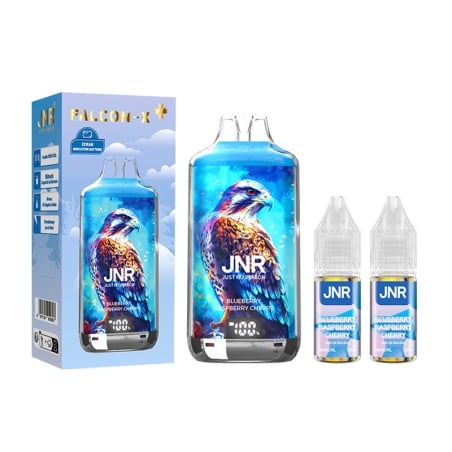
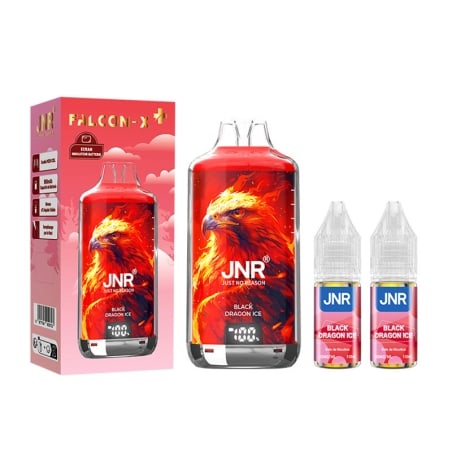
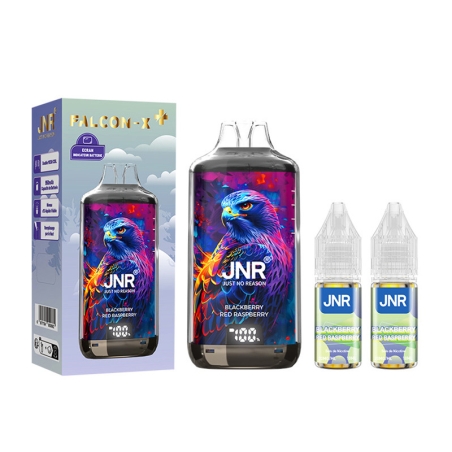
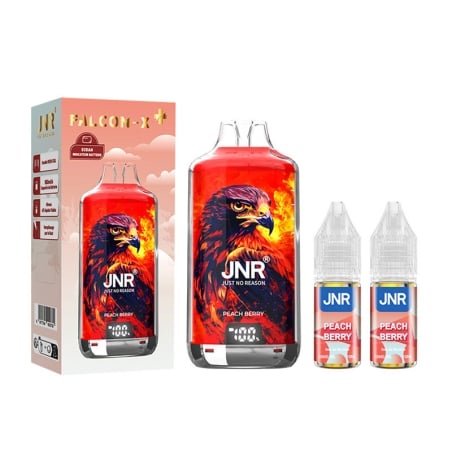
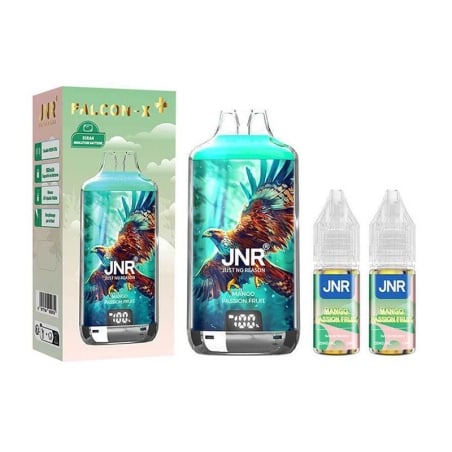
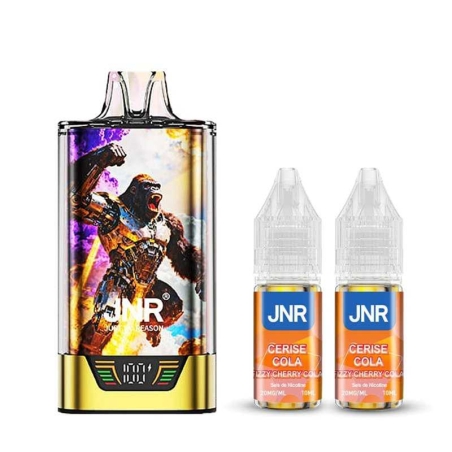
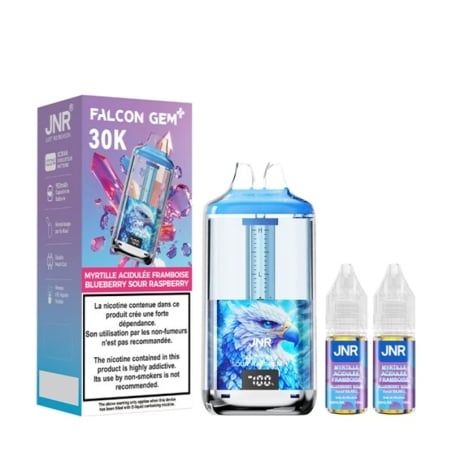
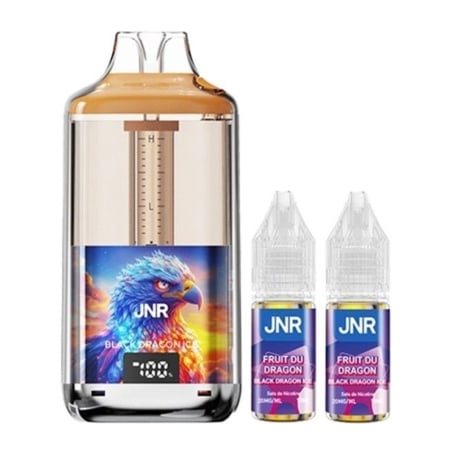
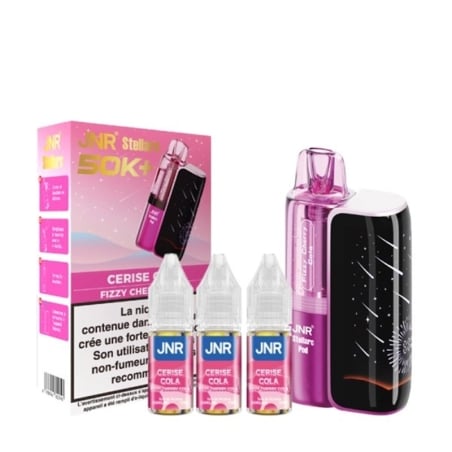
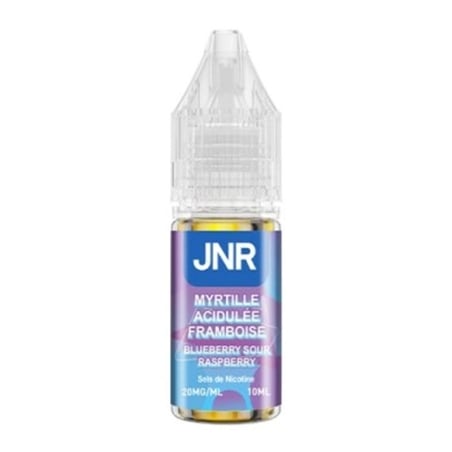
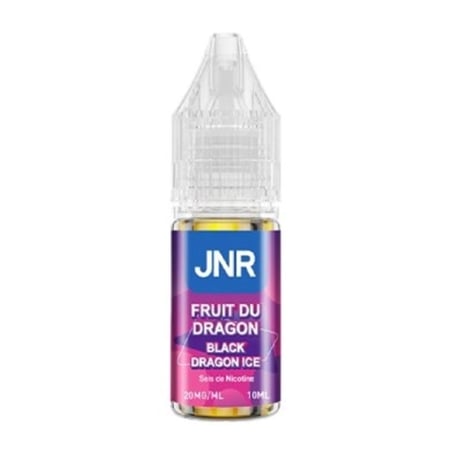
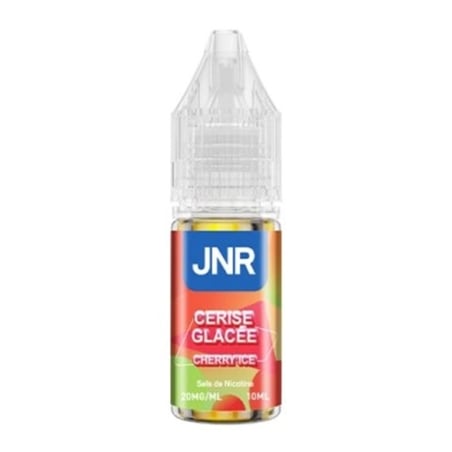
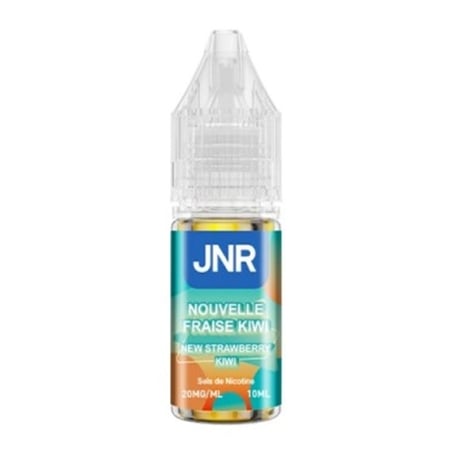
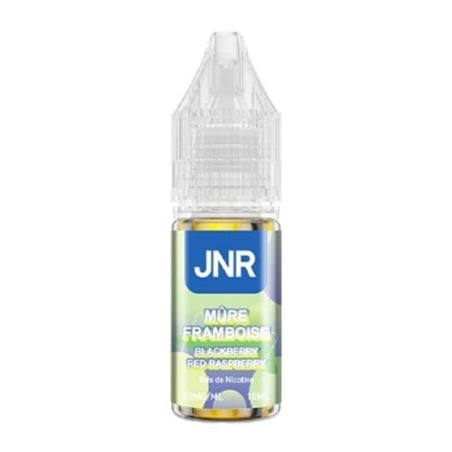
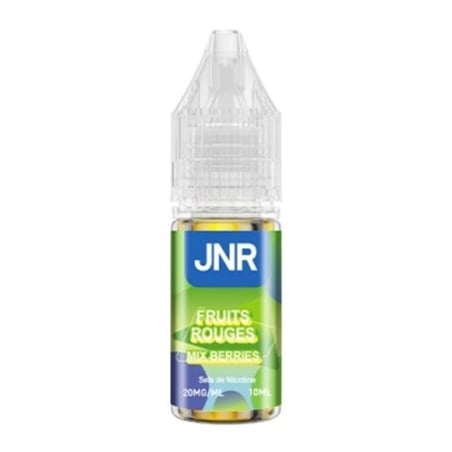
A JNR puff is a rechargeable kit: a device with a USB-C rechargeable battery, a 2 ml tank or cartridge, supplied with 10 ml bottles of JNR nicotine salt e-liquid (usually two bottles, three for the Stellarc 50K). JNR e-liquids have a 50/50 PG/VG formulation.
Here are the strengths available on the main models in our catalogue at the time of writing:
In practical terms, a 20 mg/ml kit contains 40 mg of nicotine in the full tank and 200 mg in each 10 ml bottle. The number of puffs shown in the model name (28K, 43K, etc.) is the manufacturer's estimate: it depends on the supplied liquid and varies greatly from one vaper to another. To find out more about the brand, read why the JNR puff is so successful and our top 7 JNR puffs.
For JNR puffs, 20 mg/ml is by far the strength most often chosen by our customers. This makes sense: a smoker switching to a puff often needs a sufficient dose to avoid experiencing cravings. That does not necessarily make it the right strength for everyone: a light smoker will often be better suited to 10 mg/ml.
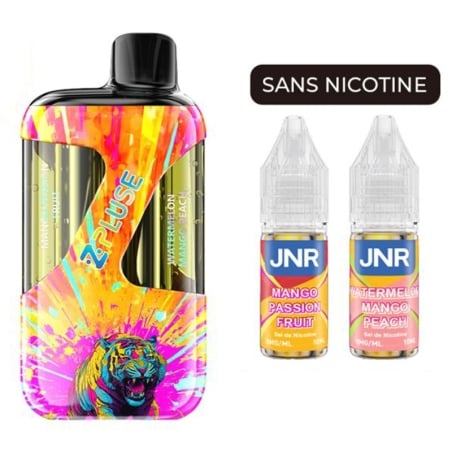
Nicotine-free versions (0 mg/ml) are aimed at former smokers who have finished reducing their nicotine intake and retain the habit and flavours until they can do without them. They are not a gateway: Anses recommends avoiding any action likely to encourage people to start vaping, particularly non-smokers and young people[8]. And vaping without nicotine is not risk-free, as we will see below. Our selection of nicotine-free puffs details the models available.
JNR e-liquids use nicotine salts. The nicotine is combined with an organic acid, making it generally smoother to inhale than “standard” nicotine (known as freebase nicotine) at the same strength. This makes it possible to vape 10 or 20 mg/ml in a small puff using mouth-to-lung inhalation, without overly harsh throat irritation.
A study of American smokers showed that, with nicotine salt e-liquids, nicotine enters the bloodstream as quickly as it does with a cigarette, without exceeding the amount delivered by a cigarette, and that this profile depends greatly on the device used[5]. To find out more: nicotine salts, their advantages and disadvantages, and our range of nicotine salt e-liquids.
Tabac info service points out that “there is not yet a dosing protocol” for e-liquids[6]. The right strength is the one that removes the urge to smoke without causing unpleasant effects. The guidelines below, commonly used in shops for a nicotine salt puff, provide a starting point to adjust:
| Your consumption | Suggested starting strength |
|---|---|
| Fewer than 10 cigarettes per day, first cigarette more than one hour after waking | 10 mg/ml |
| 10 to 20 cigarettes per day | 10 or 20 mg/ml depending on how you feel |
| More than 20 cigarettes per day, or first cigarette within half an hour of waking | 20 mg/ml |
| Former smoker at the end of smoking cessation | Gradual reduction to 0 mg/ml |
The time between waking and your first cigarette often says more than the number of cigarettes: it is one of the key questions in the Fagerström test, which assesses dependence in six questions.
If you do not know where to start, a smoking cessation specialist can help you adjust your strength: Tabac info service offers telephone support on 39 89[6].
Tabac info service mentions in particular[6]:
In this case, space out your puffs or switch to a lower strength.
Underdosing is a common trap: for fear of nicotine, many smokers choose a strength that is too low, vape continuously to compensate, then end up lighting another cigarette. It is better to start with a sufficient strength and lower it afterwards.
It is often said that a puff “is equivalent to so many packets of cigarettes”. These comparisons add up the nicotine contained in the liquid, not the nicotine absorbed. Yet absorption varies greatly according to the device, power, and the duration and frequency of puffs.
In a study published in 2016, experienced vapers took 15 puffs on their usual e-cigarette: they inhaled an average of 1.33 mg of nicotine, with substantial differences from one device and user to another[7]. Cigarettes, on the other hand, deliver nicotine through combustion in a very different way (see how much nicotine a cigarette contains).
Rather than counting packet equivalents, rely on how you feel: no more urge to smoke and no signs of overdose.
Vaping does not mean having to keep the same strength indefinitely. Many former smokers proceed in stages:
With a refillable puff, it is simple: JNR 10 ml e-liquids are available in 20, 10 and 0 mg/ml. Keep the same device and flavour; simply change the bottle when refilling your puff. Our guide to lowering your nicotine strength explains the method in detail.
The Cochrane Review, updated on 26 August 2026, concludes with a high level of certainty that nicotine e-cigarettes help more people stop smoking than nicotine replacement therapies (patches, gum): out of 100 people, 8 to 10 could stop smoking for at least six months with nicotine vaping, compared with around 6 with a replacement therapy[9]. We detail these findings in our article on the 2026 Cochrane study.
Anses, in its assessment published on 4 February 2026, considers that vaping may be considered as a temporary option for people who find it difficult to stop smoking, as part of a smoking cessation process. It also notes the possible occurrence of effects on the respiratory tract, cardiovascular system and carcinogenesis, with or without nicotine[8]. Vaping is therefore not harmless: it is a tool for quitting tobacco, not a product to use for no reason.
[1] Order of 19 May 2016 relating to nicotine-containing vaping products, Légifrance.
[2] Article L3513-5-1 of the Public Health Code, created by Act No. 2025-175 of 24 February 2025, in force since 26 February 2025, Légifrance.
[3] The sale of disposable electronic cigarettes is now banned in France, Service-public.fr, 27 February 2025.
[4] Article L3513-5 of the Public Health Code (sales to minors), Légifrance.
[5] O'Connell G, Pritchard JD, Prue C, et al. A randomised, open-label, cross-over clinical study to evaluate the pharmacokinetic profiles of cigarettes and e-cigarettes with nicotine salt formulations in US adult smokers. Internal and Emergency Medicine, 2019;14(6):853-861.
[6] Electronic cigarette nicotine strength, Tabac info service.
[7] St Helen G, Havel C, Dempsey DA, et al. Nicotine delivery, retention and pharmacokinetics from various electronic cigarettes. Addiction, 2016;111(3):535-544.
[8] Vaping: what are the health risks?, Anses, 4 February 2026.
[9] Lindson N, Livingstone-Banks J, Butler AR, et al. Electronic cigarettes for smoking cessation. Cochrane Database of Systematic Reviews, 26 August 2026.
Read the summary with
The article opens in the assistant of your choice, which summarises it for you.
Add a comment